Agent Personas Need Evidence Graphs
Memory helps an AI system remember facts. Identity needs proof across sessions.
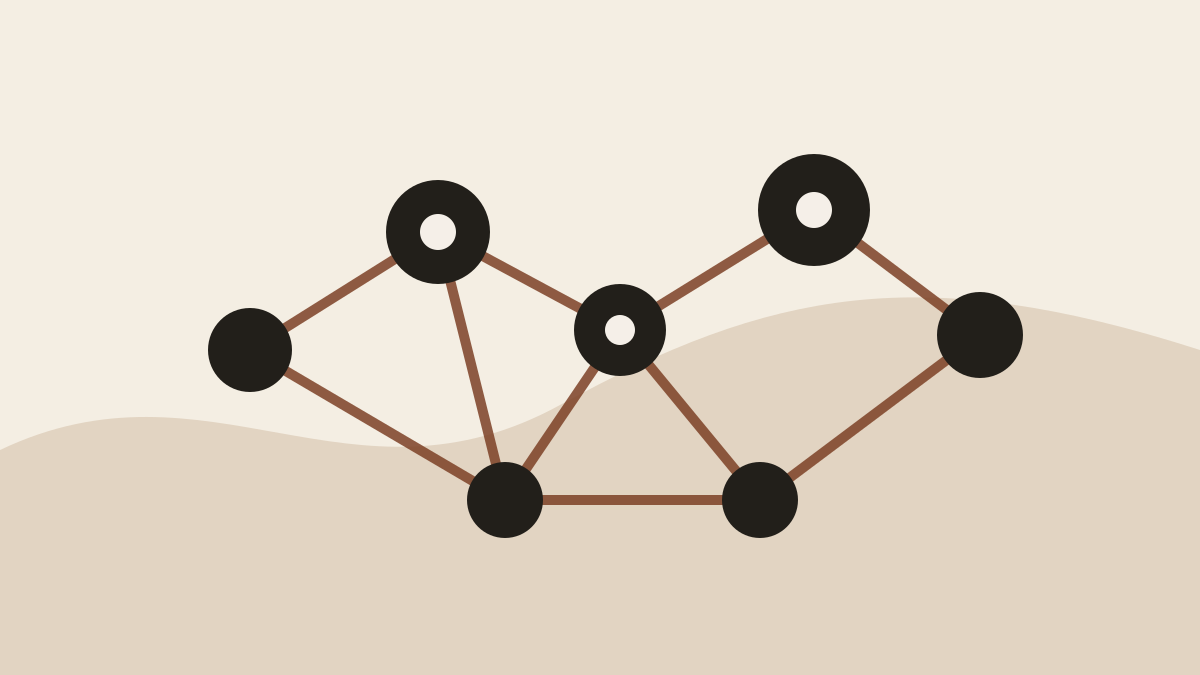
Agent personas are evidence-backed profiles built from conversations, skills, preferences, and repeated behavior. The useful version is inspectable: a team can see why a fresh chat matches an existing profile, which evidence supported the match, and where the system should stay uncertain.
Most AI products treat continuity as a memory problem. Save the user's preferences, summarize a few conversations, attach the result to the next chat, and the product starts to feel persistent.
That gets the first demo moving. It does not solve the harder product question: is this the same person showing up again, and can the system explain why?
The Agent Personas project frames the sharper primitive directly. Its README describes the product as an identity layer for AI-native software: ingest conversations, build evidence-backed persona graphs, detect whether a fresh conversation belongs to the same person, and reuse that persona for testing, personalization, or continuity.
The demo is small on purpose
The first useful demo is deliberately narrow. Talk to five people. Build five persona profiles. Start a new anonymous chat. Ask the system which prior persona, if any, the new chat resembles. Return the winning match and explain the evidence.
The narrowness is the point. A broad personality engine can hide behind vibes. A five-person recognition demo has fewer places to hide. If the system picks the wrong person, the team can inspect the match. If it picks the right person for the wrong reason, the failure is visible.
The repo names three dimensions for the persona quality check: memory, character, and skill. Memory covers stated facts and remembered context. Character covers preference, rhythm, judgment, and conversational pattern. Skill covers what the person can do or repeatedly demonstrates.
A useful persona engine needs all three because each one can mislead alone. Memory can be copied. Style can be mimicked. Skill can be domain-specific. The match gets stronger when several evidence types point to the same identity.
Summaries collapse the thing teams need to inspect
Persona summaries are tempting because they are cheap. A paragraph like "technical founder, likes fast iteration, prefers concise updates" feels useful in a prompt.
It is also difficult to audit. Which conversation proved the claim? Did the person say it once, or did it appear across ten interactions? Was it a stable preference or a context-specific choice? Did the summary merge two different people because both sounded like founders?
An evidence graph gives the product team handles:
- claim: the person prefers direct operational updates
- support: three conversation excerpts from different days
- counter-signal: one long-form planning session where detail was requested
- confidence: high for work updates, weaker for personal topics
- usage: safe for assistant tone, unsafe for sensitive decisions
The graph form matters because it preserves uncertainty. A summary tends to sound finished. A graph can show confidence, conflict, and provenance.
Synthetic users need provenance too
Agent personas become more valuable when they feed synthetic testing. A product team can ask a saved persona to pressure-test onboarding, pricing, support flows, or feature language. The system can simulate how a known user type might react before the team ships a change.
The risk is fake certainty. A synthetic user with no evidence trail becomes theatre. It can sound plausible while reflecting the prompt writer's assumptions.
Evidence-backed personas create a better contract. The synthetic run can say which prior behavior it is drawing from, what it is extrapolating, and which claims are outside the evidence. That makes the synthetic user useful to a product team instead of merely entertaining.
The first buyer is likely a team with transcript-heavy work: interviews, Discord communities, support logs, playtests, or onboarding chats. Those teams already have the raw material. Their problem is that the material does not turn itself into reusable product judgment.
The core product surface is the explanation
The Agent Personas site says the system should make the product legible in under twenty seconds and convert interested teams into pilots. The strongest version of that product story is not a generic persona dashboard. It is an explanation page for a specific identity match.
Show the fresh chat. Show the candidate personas. Show why one candidate won. Show the memory evidence, character evidence, and skill evidence. Show the strongest counter-signal. Show the confidence boundary.
That page is the trust surface. It tells a founder whether the model is matching identity or just matching language. It tells a research team whether a synthetic participant is grounded enough to use. It tells a community operator whether a Discord agent understands a member or merely remembers a fact.
The failure mode is over-personalization
Identity systems can become invasive quickly. The product needs a stop condition before it becomes a profiling machine.
A safe first rule is simple: use persona evidence to improve continuity, testing, and explicit product workflows, not to infer sensitive traits or make hidden decisions about people. The system should show its evidence and allow deletion, correction, and non-match outcomes.
The non-match outcome is especially important. A system that always picks the closest persona will eventually force strangers into old profiles. The demo should reward "unknown" when the evidence is weak.
The wedge is Discord continuity
Discord communities are a practical starting point because they contain repeated conversation, public context, and operational pain. A community agent that remembers useful context, recognizes recurring members, and avoids generic bot drift has a clear job.
The broader category is larger: AI companions, adaptive games, user research, support, onboarding, and agent products that need continuity across sessions. But the first wedge should stay concrete. One community. One recognition flow. One explanation page. One pilot intake path.
The article-worthy claim is not that AI needs better memory. It is that AI products need identity evidence they can inspect.
Related -> Google's AI Endgame Is the Interface
Max Petrusenko writes about AI agents, safety controls, and the incentives that decide whether powerful tools stay usable. Follow him on Medium, X, or LinkedIn.